Since the Patient-Driven Groupings Model (PDGM) took over in 2020, home health reimbursement has never looked the same. Yet six years in, many agencies still treat PDGM like a flat per-episode payment. It isn't. It's a 432-case-mix engine where small documentation choices can move a 30-day payment by hundreds — sometimes thousands — of dollars.
This guide breaks down how PDGM actually pays, where agencies lose the most money, and a practical 2026 playbook your clinical, coding, and billing teams can use this week.
What PDGM Really Pays For
PDGM divides every home health episode into two 30-day payment periods. Each period is grouped into 1 of 432 Home Health Resource Groups (HHRGs) based on five variables:
- Admission source — institutional or community
- Timing — early (first 30 days) or late
- Clinical grouping — 12 groups based on principal diagnosis
- Functional impairment level — low, medium, or high (driven by OASIS)
- Comorbidity adjustment — none, low, or high
Every one of these is documented before the claim ever leaves your office. That means the entire revenue outcome of an episode is decided in the chart, not in the billing software.
The 5 Reasons Agencies Lose Money Under PDGM
1. Inaccurate OASIS-E Scoring
OASIS drives the functional impairment level. Underscoring grooming, transfers, or ambulation by a single point can drop a period from a high-functional to a medium-functional category. Across a 60-patient census, that can mean six figures of lost revenue per year.
2. Missing Comorbidity Capture
The high-comorbidity adjustment requires two qualifying diagnoses from interacting groups. Most agencies capture one. Coders should review the full 60-day medication list and recent hospital discharge summaries — not just the referral.
3. Late Notice of Admission (NOA)
Since 2022, a Notice of Admission must be filed within 5 calendar days of the start-of-care date. Miss the window, and Medicare reduces payment one-thirtieth of the period rate for every day late. Agencies still routinely lose entire periods this way.
4. Misclassifying Admission Source
An "institutional" admission (acute hospital, SNF, IRF, LTCH in the 14 days prior) pays meaningfully more than a "community" admission. Yet billers often default to community when discharge documents are missing. Always verify the prior 14-day inpatient history.
5. LUPA Thresholds Not Tracked in Real Time
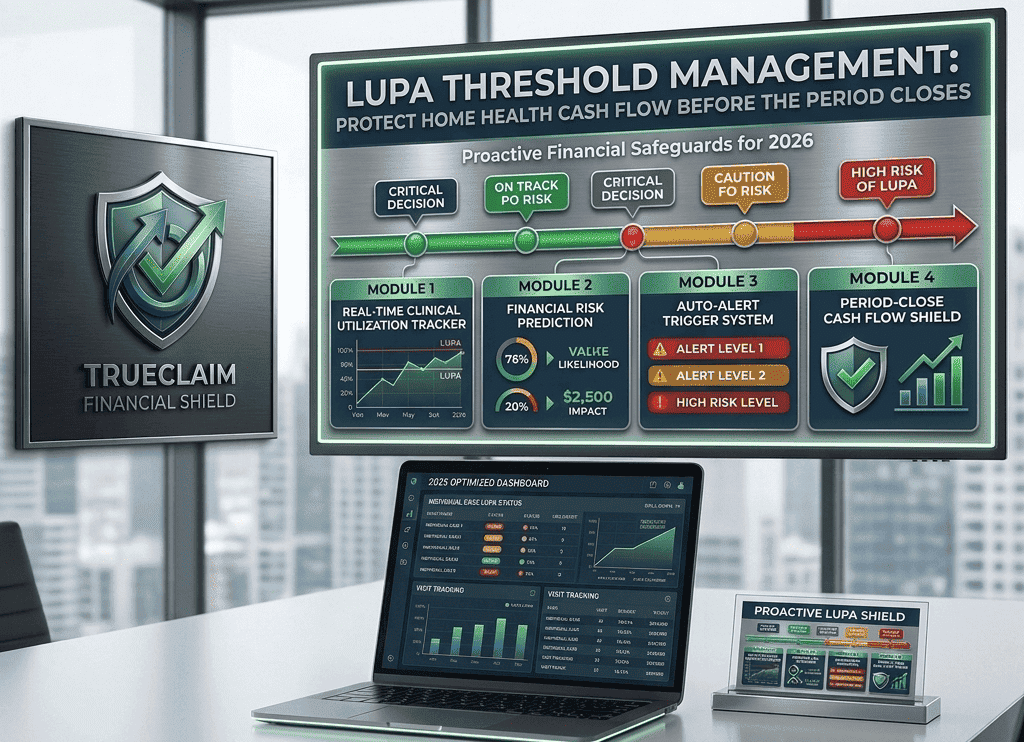
Each HHRG has its own Low Utilization Payment Adjustment threshold (2 to 6 visits). Fall under it and the entire 30-day period drops to a per-visit rate — typically 60–70% less revenue. Most agencies discover LUPAs after the period closes, when it's too late.
A Practical 2026 Playbook
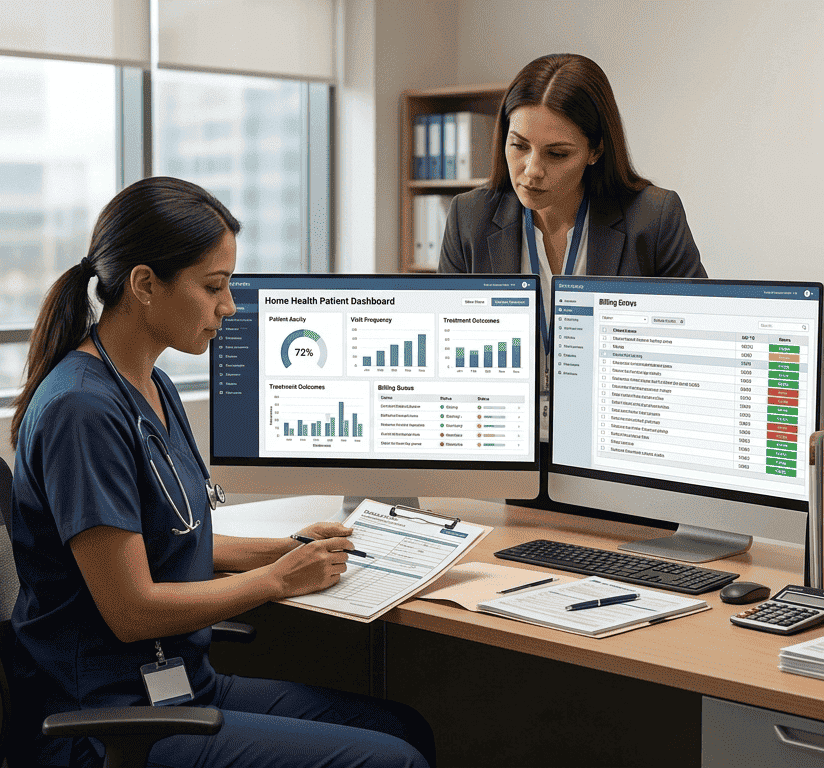
Build a Weekly Clinical-Coding-Billing Huddle
Pick 15 minutes every Monday. Review the prior week's start-of-care, recertifications, and periods that closed within one visit of a LUPA threshold. This single meeting tends to recover 3–5% of revenue inside the first quarter.
Audit Every OASIS Before Lock
Use a second-clinician review for the high-impact M-items: M1800 (grooming), M1810 (upper body dressing), M1830 (bathing), M1850 (transferring), M1860 (ambulation), and M1033 (risk for hospitalization). These six items drive most of your functional and comorbidity revenue.
Track LUPAs Daily
Your EMR should flag any period running below its HHRG threshold by day 20. If it doesn't, build a manual census report. Catching a LUPA risk at day 20 gives clinicians time to add medically necessary visits.
Code Comorbidities From the Whole Chart
Train coders to read the H&P, recent hospital discharge summary, and current medication list — not just the referral form. Diabetes with neuropathy, CHF with COPD, and stroke with depression are common high-comorbidity pairs that go unbilled.
Verify Admission Source Within 48 Hours
Every new admission should have admission-source verification (Common Working File or discharge documents) completed within two business days. This single workflow change protects an average of $300–$500 per qualifying period.
2026 Updates You Cannot Ignore
The CY 2026 Home Health PPS Final Rule continues the behavioral assumption adjustment and finalizes new wage index changes. Agencies in metropolitan areas with reclassified CBSAs should re-model their payment rates before January 1 — last year's per-period assumptions will be wrong.
CMS is also expanding HHVBP (Home Health Value-Based Purchasing) measure weights. Functional-improvement OASIS items now carry more weight in your Total Performance Score, which means OASIS accuracy is no longer just a billing issue — it's a 5–7% payment-adjustment issue.
Conclusion
PDGM rewards agencies that treat documentation as a revenue function, not a paperwork function. The agencies winning under PDGM in 2026 are not the ones with the most patients — they are the ones whose OASIS, coding, and billing teams talk to each other every week.
If your agency is losing periods to late NOAs, missed comorbidities, or surprise LUPAs, a focused 30-day PDGM audit usually finds 4–8% of recoverable revenue. Request a free home health billing audit from TrueClaim RCM and we will show you exactly where it's hiding.
Want this analysis run on your own claims?
TrueClaim RCM offers U.S. healthcare providers a free, no-obligation billing audit — see your real numbers, not industry averages.
Get a Free Billing Audit