For home health agencies operating under PDGM, no single number quietly destroys margin like the LUPA. The Low Utilization Payment Adjustment converts a full 30-day period payment — often $2,000 to $3,500 — into a per-visit rate that typically pays 60–70% less. A single missed visit can do it.
And yet most agencies still discover LUPAs after the period closes, when there is nothing to fix.
This guide explains what triggers a LUPA, what it costs, and how to build a real-time LUPA management workflow that protects revenue before the period ends.
What Is a LUPA Under PDGM?
A LUPA is triggered when a 30-day period of care has fewer than the threshold number of skilled visits assigned to its specific Home Health Resource Group (HHRG). PDGM has 432 HHRGs, and each one has its own LUPA threshold ranging from 2 to 6 visits.
When a period falls below its threshold, Medicare pays per-visit rates instead of the case-mix-adjusted episode payment. The first LUPA in a sequence also triggers a small upward adjustment, but it never makes up for the lost episode payment.
Why LUPAs Cost More Than Agencies Realize
Consider a typical 30-day period with a 5-visit LUPA threshold paying ~$2,800 at the full case-mix rate. Deliver 4 skilled visits, and that same period might pay ~$640 (4 visits at ~$160). The agency just lost $2,160 on one patient — and absorbed the cost of three home visits to do it.
Multiply that across an agency with even a 6% LUPA rate, and the annual leakage often exceeds $300,000.
The Real Causes of LUPAs
1. Discipline-Specific Visits Counted Wrong
Only skilled disciplines (SN, PT, OT, ST) count toward the LUPA threshold. Home health aide and MSW visits do not. Schedulers often plan to the total visit count and miss the skilled count.
2. Patient Refusals and Hospitalizations
Two refused visits in week three of a period are often the difference between a full payment and a LUPA. Agencies that don't track refusals in real time discover the LUPA at billing.
3. Weekend and Holiday Gaps
Plans of care that put all 5 weekly visits Monday–Friday leave no buffer for a sick clinician or canceled visit. A scheduling pattern with one weekend visit per week dramatically lowers LUPA risk.
4. Late-Period Discharges
Discharging a patient before the 30-day period ends — for hospitalization, transfer to hospice, or sudden improvement — often locks in a LUPA. The visit threshold doesn't get prorated.
5. Misjudged Clinical Need
Clinicians sometimes reduce visits because the patient "looks fine," not realizing that the plan of care set the LUPA threshold at 5 and the patient is now sitting at 3.
A Real-Time LUPA Management Workflow
Day 0 — Set the LUPA Target at SOC
The day the plan of care is built, the system should display the period's LUPA threshold. If the planned skilled visits equal the threshold exactly, the plan is already at risk. Plan for at least one buffer visit.
Days 7, 14, 21 — Triple Check-In
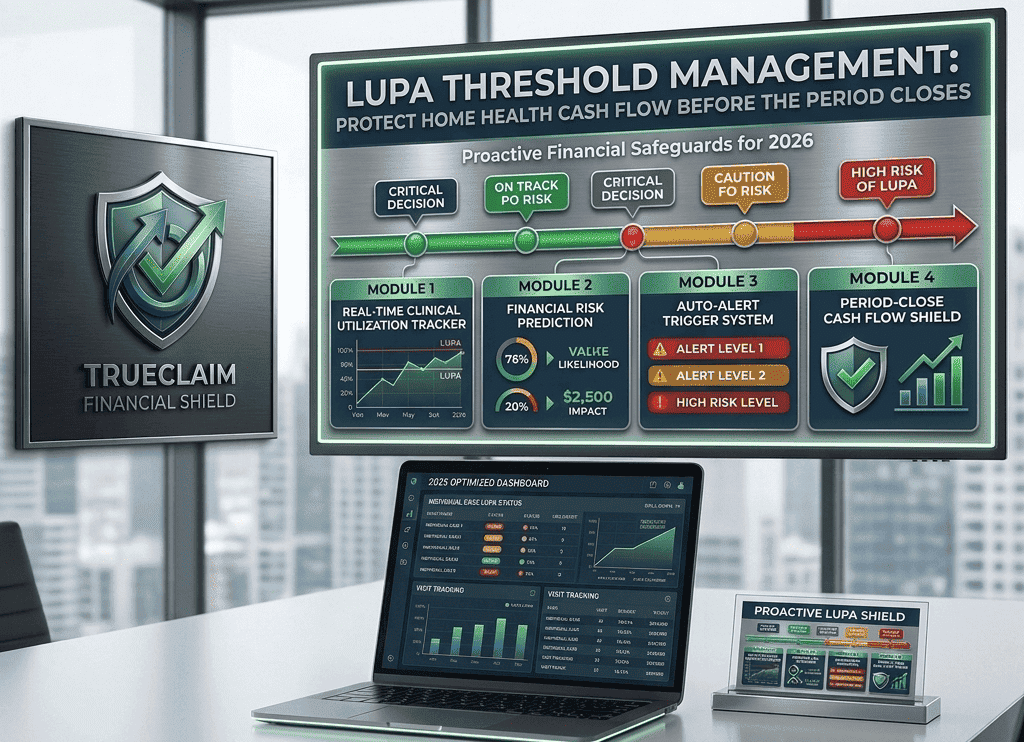
Run a LUPA-risk report at days 7, 14, and 21 of every period. Flag any patient whose remaining scheduled skilled visits plus completed visits is less than (threshold + 1).
Day 20 — Hard Escalation
By day 20, any period below threshold should be escalated to the clinical manager. Six days remain — enough time to add medically necessary visits, but only with action this week.
Day 26 — Final Recovery Window
The last four days of a period are the recovery window. Document the clinical justification for any added visits, and ensure they are completed and signed before the period closes.
Distinguishing LUPA Prevention From Fraud
Adding a visit only to avoid a LUPA — without clinical justification — is non-compliant. Every added visit needs documented medical necessity. The right way to prevent LUPAs is to plan more conservatively at SOC, not to manufacture visits at day 27.
This is why agencies with strong PDGM performance front-load the plan of care: more visits in weeks one and two, when clinical need is highest, with buffer visits scheduled later.
LUPA Performance Benchmarks for 2026
- Agency-wide LUPA rate: ≤ 6% is high-performing; > 10% is a margin emergency
- LUPA rate by clinical grouping: review monthly — neuro and behavioral groupings tend to LUPA more often
- LUPA recovery rate (periods flagged at day 20 that ended above threshold): ≥ 70%
If your EMR cannot report these three numbers, you are flying blind on one of the most important cash-flow metrics in home health.
What's Changing in 2026
The CY 2026 Final Rule maintains LUPA thresholds with minor adjustments tied to behavioral assumptions. CMS has also signaled increased Targeted Probe and Educate (TPE) reviews of agencies with unusual LUPA patterns — both too high (margin loss) and unusually low (potential utilization concerns).
Conclusion
LUPAs are not a billing problem. They are a scheduling and clinical-planning problem that becomes visible to billing too late. Agencies that win on LUPAs treat the threshold as a hard floor at SOC and run real-time reports on days 7, 14, 20, and 26 of every period.
If your LUPA rate is over 8% or you don't know what it is, TrueClaim RCM can run a free LUPA audit on 60 days of your closed periods and quantify exactly how much margin is recoverable.
Want this analysis run on your own claims?
TrueClaim RCM offers U.S. healthcare providers a free, no-obligation billing audit — see your real numbers, not industry averages.
Get a Free Billing Audit