
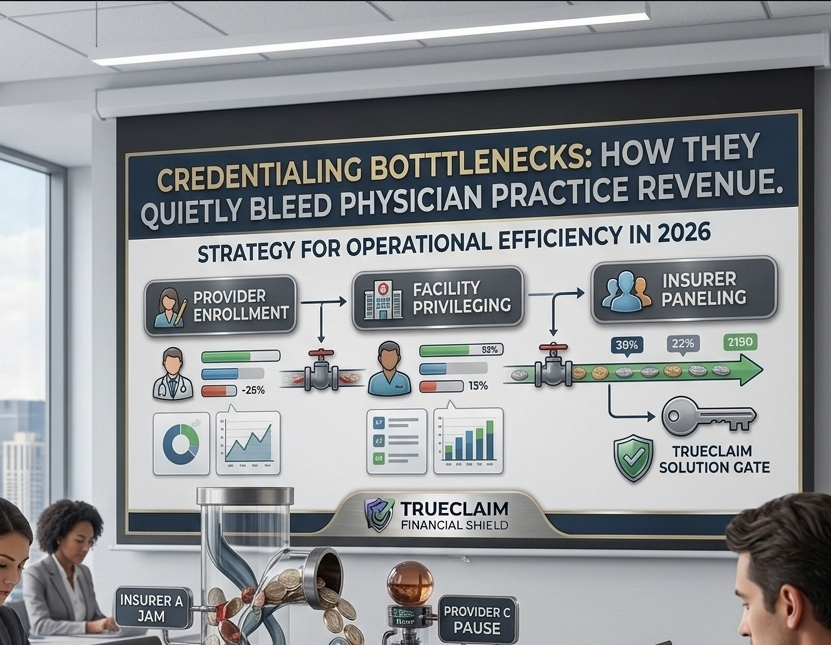
Credentialing is often treated as a back-office paperwork function, until a newly hired physician sees 80 patients a month for 90 days and the practice can't bill a dollar of it. By the time the bills come due, the loss is six figures and unrecoverable.
Credentialing is one of the highest-ROI investments in physician revenue cycle management. Done well, it adds weeks of billable time to every provider. Done poorly, it quietly bleeds revenue that nobody traces back to its source.
Here is what physician practices need to know in 2026.
What Credentialing Actually Covers
Provider credentialing is the verification process that allows a clinician to:
- Be enrolled with each payer (Medicare, Medicaid, commercial)
- Be linked to the practice's group billing TIN
- Have hospital privileges where applicable
- Maintain CAQH ProView and PECOS records current
Each of these is a separate workflow with separate timelines. "Credentialed" with one payer does not mean credentialed with all.
The Real Cost of a Credentialing Delay
For a primary care physician generating ~$30,000 per month in collections, every month of credentialing delay costs the practice $30,000 in unbillable services. For a specialist generating $70,000–$120,000 per month, the cost is proportionally higher.
Practices that wait until the physician starts to begin credentialing typically lose 90–120 days. Practices that start credentialing 90 days before start date typically lose 0–30 days. The cost difference per provider is often $60,000–$200,000.
The 6 Bottlenecks Where Credentialing Stalls
1. CAQH Profile Incomplete or Outdated
The CAQH ProView profile is the universal payer credentialing application. Missing license verifications, gaps in work history, or outdated attestations stall every payer at once.
Fix: Audit the CAQH profile within 48 hours of hire offer and re-attest every 120 days.
2. PECOS Enrollment Errors
For Medicare, PECOS enrollment is mandatory and frequently bottlenecks on practice address mismatches, incorrect specialty taxonomy, or missing reassignment-of-benefits paperwork (CMS-855R).
Fix: Submit PECOS applications electronically with all supporting documents in one package — avoid the "we'll send the missing piece later" approach.
3. Commercial Payer Backlogs
Most commercial payers quote 60–90 days for credentialing but actually take 120+ days for many networks. Some plans now require contract negotiation as a separate step after credentialing, adding another 30–60 days.
Fix: Submit to all target commercial payers in parallel on Day 1, not sequentially. Track each payer's specific application status weekly.
4. Hospital Privileging Delays
For hospital-based or hospital-affiliated practices, hospital medical staff credentialing runs on its own cycle — usually monthly credentials committee meetings. Missing one meeting can cost 30 days.
Fix: Know the credentials committee meeting calendar and reverse-plan submission deadlines.
5. License and Certification Gaps
State license issuance, DEA registration, and board certification verification each have their own timelines. A newly licensed physician moving across state lines can wait 8–16 weeks for the new state license.
Fix: Begin license applications immediately upon job acceptance, not start date.
6. Recredentialing Lapses
Most commercial payers recredential every 36 months. Miss a recredentialing window and the provider can be deactivated mid-year — generating claim denials that look mysterious until someone checks payer status.
Fix: Maintain a 90-day-out recredentialing calendar and assign ownership.
Retroactive Billing: What's Possible and What Isn't
Some payers allow retroactive enrollment back to a hire date or application date — but the rules vary widely:
- Medicare: Retroactive enrollment up to 30 days prior to application receipt date (60 days during certain public health declarations)
- Medicaid: Varies by state — some allow back to hire date, others only to approval date
- Commercial: Most do not allow retroactive billing. A few will honor the application receipt date if the contract terms allow
The practical implication: don't assume you can bill backward. Plan to be live on Day 1.
Credentialing KPIs Every Practice Should Track
- Average days from hire date to first payer enrollment (target: ≤ 60)
- Average days to full commercial enrollment (target: ≤ 120)
- Recredentialing on-time rate (target: 100%)
- CAQH profile completeness (target: 100% always)
- Denied claims due to enrollment issues (target: 0)
What's Changing in 2026
CMS continues to push for streamlined provider enrollment through the Provider Enrollment, Chain, and Ownership System (PECOS 2.0), with phased rollouts of new revalidation workflows. Practices using outdated CMS-855 paper submissions will see longer turnaround times.
On the commercial side, the No Surprises Act provider directory accuracy requirements continue to drive payers to verify provider data more frequently — meaning even small directory mismatches can trigger payer-side credentialing holds.
Outsourcing vs. In-House Credentialing
Practices smaller than ~10 providers rarely have the bandwidth to do credentialing well in-house. The math usually favors outsourcing: a credentialing service typically costs $200–$400 per provider per month but recovers far more in faster enrollment and prevented recredentialing lapses.
For practices with 20+ providers, a dedicated in-house credentialing specialist (or team) usually outperforms outsourcing — but only if the role is staffed with credentialing-specific expertise, not just front-office cross-training.
Conclusion
Credentialing is not paperwork. It is one of the most expensive revenue gates in a physician practice — and the leak is usually invisible because it shows up as "ramp-up time" rather than as denied claims. Practices that start credentialing 90 days before hire, run all payer applications in parallel, and track the five KPIs above can add weeks of billable time to every new provider.
If your last new physician took 90+ days to start billing all major payers, TrueClaim RCM's credentialing team can audit your current workflow free and quantify the time and revenue you can recover.
Want this analysis run on your own claims?
TrueClaim RCM offers U.S. healthcare providers a free, no-obligation billing audit — see your real numbers, not industry averages.
Get a Free Billing Audit